
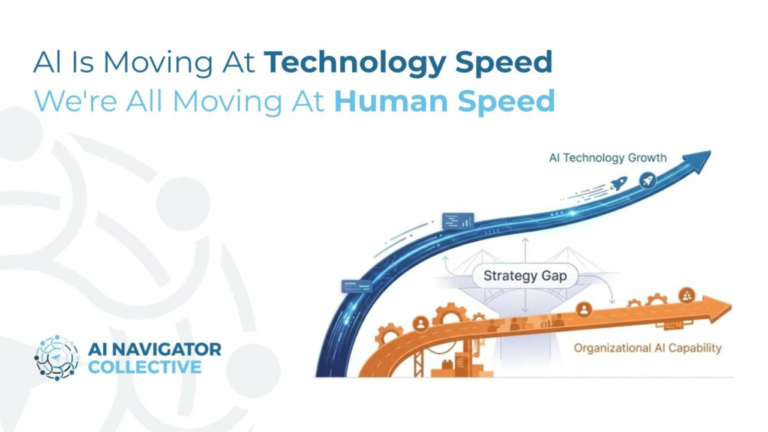
Most companies are still approaching AI as a tooling problem. In the last three years, many conversations focused on platforms, tools, subscriptions, and pilots. Leaders want to know what to buy, what to standardize on, and how quickly they can deploy something meaningful.
But the organizations creating real long-term advantage with AI are focused on something much harder to build: organizational capability. They’re redesigning workflows. Clarifying governance. Training leaders to make better AI decisions. Integrating AI into operational systems instead of treating AI like a side experiment.
That distinction matters because AI itself is rapidly becoming accessible to everyone. Models are improving quickly. Costs are falling. Capabilities that once felt revolutionary are becoming embedded into everyday business software. Which means the technology alone is unlikely to remain a durable competitive advantage for very long.
What AI Competitive Advantage Means in 2026
AI competitive advantage no longer means being first to test a chatbot or launch a pilot. In 2026, it means using AI to make the organization better at sensing opportunities, making decisions, redesigning work, serving customers, and learning faster than competitors.
Current market signals show why this matters. McKinsey’s latest global AI survey found that 88% of respondents report regular AI use in at least one business function. Yet, nearly two-thirds say their organizations have not begun scaling AI across the enterprise. Gartner also projected that by 2026, more than 80% of enterprises would use generative AI APIs, models, or GenAI-enabled applications. Basic adoption is becoming normal. It is not enough to differentiate.
Right now, many companies are still in the experimentation phase. Teams are testing tools independently. Different departments are running disconnected pilots. Employees are improvising their own approaches to AI adoption with little coordination or visibility across the organization. This phase is normal. Every major technology shift begins with experimentation. But experimentation alone does not create transformation.
At some point, organizations have to move beyond asking: “What can this tool do?” and start asking: “Where can AI create value in our business, and on what time horizon?”
That shift changes the conversation completely.
Once leaders begin evaluating AI through the lens of business value and time horizon, they stop thinking purely about tools and start thinking about operational design, prioritization, sequencing, governance, and organizational readiness.
They begin distinguishing between what can bring their company a quick win, what will yield a return on investment from changing the way work happens, and how to level up the way they compete in the marketplace. They stop chasing disconnected experiments and start evaluating where AI can meaningfully improve workflows, decision-making, customer experience, and long-term competitive positioning.
That is where real transformation starts to happen.
Meaningful AI integration rarely comes from simply inserting a tool into an existing workflow. In many cases, the workflow itself has to change. Decision-making structures have to change. Roles shift. Handoffs evolve. Governance becomes more important, not less.
Most organizations are still underestimating this. They assume AI transformation is primarily a technology initiative when it is actually an organizational redesign challenge. The hardest problems are usually not technical. They are operational.
How should work move through the organization? Where does human judgment matter most? What should be automated versus augmented? Who owns governance? How do teams adapt continuously as the technology evolves?
Those are leadership questions. And this is where capability starts to compound.

Organizations that build internal AI leadership, governance structures, workflow redesign capabilities, and operational learning systems improve their ability to adapt every time the technology changes. Each implementation creates institutional knowledge. Each workflow redesign improves future redesign efforts. Each successful deployment increases organizational confidence and decision-making maturity.
Meanwhile, organizations focused only on tools often find themselves restarting every few months. New platform. New pilot. New excitement. But very little operational integration.
The companies that will ultimately create sustainable advantage with AI will not necessarily be the companies that adopt the most tools first. They will be the companies that build the internal capability to continuously evaluate, prioritize, integrate, govern, and adapt AI as the technology evolves.
Because eventually, most organizations will have access to similar technology. What they will not have is the same ability to operationalize it effectively.
That is becoming the new competitive advantage. And this is what we’re focused on at the AI Navigator Collective.
Our ResourceFinder can support this stage by helping leaders access AI training. Our Navigator Pathway gives a structured sequence for readiness, opportunity identification, planning, implementation, and continuous improvement. For enterprises serious about AI strategy beyond tooling, the next step is to build an internal operating model that connects people, process, governance, and measurable value. Explore AI Navigator Collective to understand the broader capability-building approach, or contact the AINC team if the organization is ready to move from scattered AI experimentation to a structured enterprise pathway.
