

AI is already operating within your company; it’s preparing marketing emails, proposing answers in your help desk, sorting through spreadsheets, and is present in the various tools you’ve been using for years. In most cases, it isn’t even given the label ‘AI’.
AI governance consists of the rules and decisions that determine which AI tools you should use, how to use them, and who is to be held responsible if anything goes wrong. The problem is that nearly all the guides on this topic have been written with large enterprises in mind—enterprises that have governance committees, dedicated risk teams, and budgets that you don’t possess. This particular guide is an exception.
The following are 12 practices that are appropriate for a genuinely small or mid-sized business; you will be able to implement most of them this month, and none of them should cause any delays.
Key takeaways
- Governance is a system and not merely a collection of paperwork; for a small business, this involves having a simple structure, one person who owns it, and then carrying out periodic reviews. A committee is not necessary.
- Your main risk is data exposure, and this typically occurs when someone pastes sensitive information into a consumer AI tool.
- Start with the AI that you currently use; you can’t control something that you can’t see, and you never realize just how much there is.
- Align the level of your effort with the level of risk and direct the majority of your attention to anything that is facing customers or is linked to a real decision.
- Certain rules already apply to you, for example, the literacy obligation under the EU AI Act, which applies to organisations that simply use AI.
- The majority of these expenses involve time rather than money, and good governance mainly requires attention, which is free.
What AI governance means for a small business
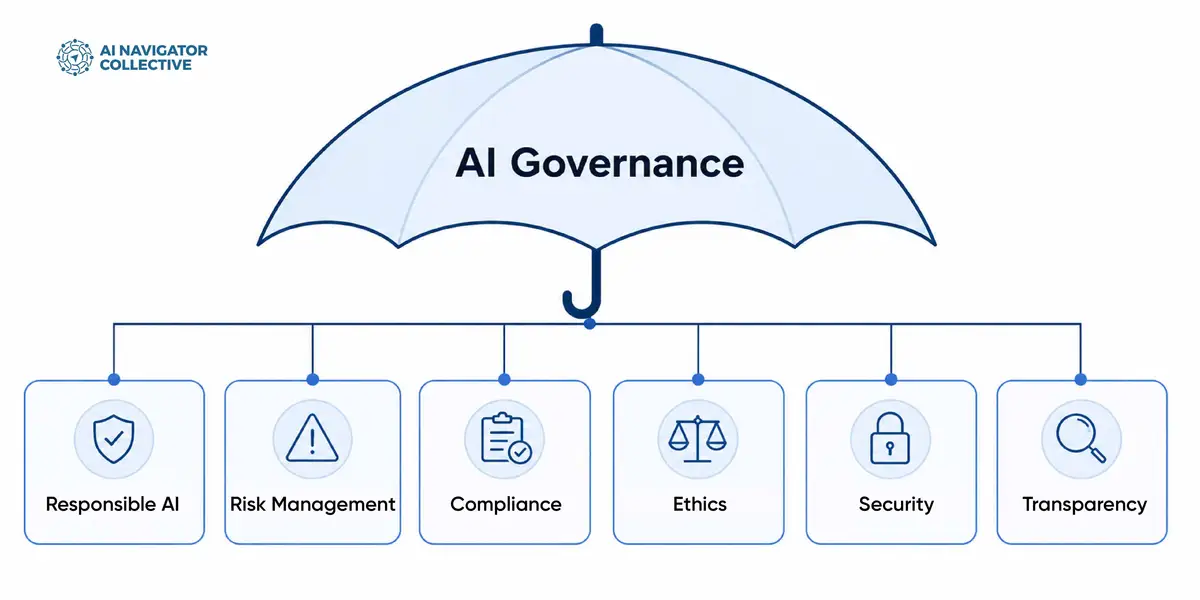
Stripped down, AI governance is how you keep AI helping your business instead of quietly creating legal, security, or trust problems. It covers four things: which tools you permit, what data you allow into them, who is to be held responsible, and how you check that all of this is in fact, working.
When it comes to large enterprises, this means setting up governance boards, maintaining model-risk registers, and having teams whose entire role is to carry out this responsibility. At your level, the requirements are far less demanding. You just need a brief policy, a single named owner, a few common-sense rules, and a meeting every quarter to deal with most of it. If you want to know more about what AI governance entails, our explainer provides a more detailed account.
Several related terms are mentioned as though they had the same meaning. In fact, here is how they relate to one another:
| AI governance | The overall system for how you choose, use, and oversee AI |
| Responsible AI | The values behind it: fairness, transparency, accountability |
| AI risk management | Spotting and reducing the specific harms AI can cause |
| AI compliance | Meeting laws and standards (EU AI Act, GDPR, sector rules) |
| AI ethics | The broader “should we?” questions about the impact on people |
| AI security | Protecting AI tools and data from misuse or attack |
| AI transparency | Being open about when and how AI is used |
Governance is the overarching category; all the other things are under it.
Actually, do you need it?
If any member of your team uses AI, even something as simple as ChatGPT or Microsoft Copilot, then the answer is yes. There’s no need for a formal policy—you just need a few rules. Nowadays, clients, insurers, and auditors are beginning to ask questions about the way you handle AI, so it’s an uncomfortable thing to have to reply that you don’t.
The 12 AI governance best practices for organizations
1. Begin by identifying your “shadow AI”
You can’t control a tool of which you are unaware, so begin with a one-page audit by asking each team which AI tools they are using and why they are using them, then include any AI features that are built into the software you are already paying for.
The initial check usually reveals something that no one has mentioned—such as a free transcription app that has been installed or an AI writing addon hidden in the browser. Any item that involves customer data, money, or personal information should be flagged. Although this is a simple task, it replaces guesswork with a real list.
2. Adjust the level of governance according to a simple risk rating.
You shouldn’t wholesale copy an enterprise framework. Instead, divide your activities into three tiers and direct your efforts to where they make the most difference. That is the fundamental principle of a reasonable risk-tiered governance model.
| Low | Internal note-taking, brainstorming, content drafts | Light basic rules, no approval |
| Medium | Tools that shape business decisions or analysis | Moderate review outputs, set limits |
| High | Customer-facing systems: hiring, lending, eligibility | Strict human sign-off, monitoring, records |
Put the bulk of your attention on the High tier, and let low-risk experimenting run free.
3. Name one accountable owner, not a committee
Shared ownership often ends up meaning that nobody actually owns it. Choose one person to act as your ‘AI lead’; in a small company this is generally either the person who manages the operations, the most technically knowledgeable generalist, or the founder. Assign them a regular slot on the calendar so that the matters remain up to date.
A single person who does in fact turn up is still able to outperform a six-member committee that never meets, and you can form a real AI governance committee later on; for a small team the best starting point is a single owner.
4. Draw up a simple AI usage policy in ordinary language
People will only follow rules that they are able to find and understand. The acceptable-use policy should be limited to one page and should include the essential points such as which tools are permitted, which uses are prohibited, what data must never be included, and who to contact when there is any uncertainty.
Don’t use all that legal jargon. A single page that your team will read is far more useful to you than a thirty-page document that no one opens. If you’d like to get off to a good start, our examples of an AI acceptable-use policy are available for you to adapt.
5. Set clear rules for handling data. This is your biggest risk.
Almost all the problems concerning AI in a small business can be traced to a single cause: sensitive data ending up in a place where it shouldn’t. The most basic form of protection is to divide your data into three categories—public, internal, and confidential or regulated.
Then teach everyone one rule. Never paste confidential, customer, or regulated information into a consumer
AI tool, and turn off model-training settings wherever the tool lets you. The plainer version, the one people actually remember: if you wouldn’t email it to a stranger, don’t paste it into a chatbot.
6. Vet your AI tools and vendors
Each time you use a third-party tool, you’re giving someone else’s model access to your data. Before making a decision, quickly check the vendor to see whether it trains on your inputs, if there is a business tier that offers better data protection, whether it holds SOC 2 or ISO 27001 certification, and where the data is actually stored.
As most small businesses choose to use AI rather than develop it themselves, it is in this area that your actual exposure lies. We go into it more in our guide on managing AI risk.
7. Ensure that a human is involved when it comes to important decisions
If a decision involves a person, AI may be used to help with it but should not be the only one to make it. You should put in writing those cases where a human review is always necessary—such as hiring and screening, lending, terminations, and eligibility—and also state who gives the final approval.
The new regulations are based on this very point, making it a legal protection as well as a sensible measure; having a human involved in the decisions that matter protects both your customers and yourself.
8. Develop a basic level of AI literacy among your team
Guardrails only function if people understand them, and a bit of regular training makes a big difference in this area—on matters such as data privacy, bias, and how to sanity-check what the AI provides. All that’s needed is fifteen minutes added to each monthly team meeting.
There is also a legal incentive at work here. Since February 2025, Article 4 of the EU AI Act has required organisations that use AI to help their staff with their AI literacy. The standard set is one of literacy rather than expertise; people generally just need to know how to use these tools sensibly and when to be skeptical.
9. Be open. Say when you use AI and mark content made by AI.
Honesty is the basis of trust, and the rules regarding disclosure are already becoming more stringent. Inform customers when they are speaking to a chatbot. Make sure that AI assistance is labelled in cases where this is important. Stick to the facts internally about the role of AI.
Disclosure is just a cheap form of insurance; a single line stating that “this reply was drafted with AI and reviewed by our team” costs you nothing and prevents a much larger blow to trust in the future.
10. Before and while using it, check for both bias and accuracy.
An insignificant tool can produce results that are unfair or simply incorrect. When you carry out a spot check on any tool that is customer-facing or involved in making a decision, compare its answers with cases in which you already know the correct answer, and keep a careful watch on anything that ranks or scores individuals.
A data-science team isn’t necessary since free and open-source fairness toolkits can carry out the basic bias checks and merely spending five minutes each week looking at the outputs picks up most cases of accuracy drift before any customer sees it.
11. Keep a close watch on it, record it, and make light notes, but in a consistent manner
The objective is simple in that you should firmly answer the question, ‘How do you manage AI?’ You should maintain a common record of your tools, noting who owns them, their risk levels, and any important decisions, and also make notes regarding complaints about AI output or any changes that a vendor has introduced.
What matters most in this case is consistency, and one living document is all that is needed. This is the difference between giving a direct answer and having to make an awkward pause when a client or an insurer asks a question.
12. Keep reviewing and updating on a regular schedule
Since AI tools and the relevant laws are constantly evolving, it’s necessary to carry out a quick review every quarter. Go through your inventory, your policy, and your risk categories, and increase training in those areas where it is required. Governance functions more effectively when it is regarded as an ongoing habit rather than as a single-project effort.
It is also the right time to consider whether or not you need outside assistance. The more you use AI, the more established frameworks for responsibly adopting AI can ensure that your approach stays up-to-date so that you are not having to reinvent it each year.
Your 30-day AI governance starter plan
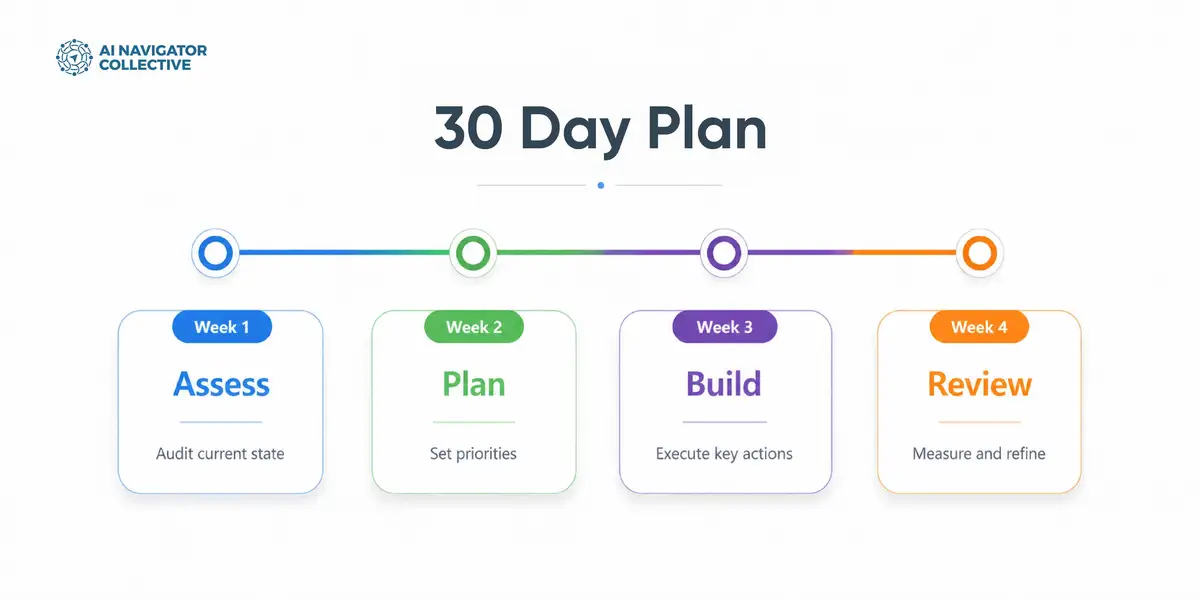
You can stand the basics up in a month:
- In week one, carry out the inventory and state who the owner is.
- Week 2: Put your tools and data into risk groups. Mark each high-risk use.
- In week three, draft and share the one-page policy and turn on your vendors’ data protections.
- In week four, hold a thirty-minute team session on literacy and decide the date for the first quarterly review.
That’s the entire point: scattered, invisible use of AI over a period of four weeks becomes something you can point to and have the strength to stand behind it.
Common AI governance mistakes SMBs make
- Copying a company plan that expects staff and money you don’t have.
- Drafting a policy that isn’t read for very long, that is too legal, and is never actually shared.
- To completely ban AI would only cause it to operate underground.
- Overlooking the AI that is already built into your software by the vendor.
- Treating it as set-and-forget instead of revisiting it each quarter.
The fix for all five is the same: start small, keep it visible, and look at it again on a schedule.
How much governance is enough, and when to get help
For most small businesses, the twelve practices above really are enough. How much you need scales with your risk. A marketing agency using AI to draft copy needs far less rigor than a clinic handling patient records or a firm running AI in its hiring.
Bring in outside help: a managed service provider, a virtual CISO, a fractional compliance advisor once you’re handling regulated data, serving EU customers, or letting AI into decisions about people. Short of that, this is well within reach of an in-house team. If you’re operating at board level or larger, our guide to corporate AI governance best practices covers the heavier structures.
The future of AI governance for small businesses
A few shifts are worth keeping an eye on.
The first is agentic AI: tools that take actions instead of just producing text. That raises the bar for oversight, because now a mistake can actually do something rather than just suggest it.
The second is regulation settling into place. The EU AI Act is rolling out in phases through 2026 and past it, and US states aren’t sitting still either. Colorado, for instance, scrapped its original AI law and replaced it with a narrower, disclosure-focused one (SB 26-189) that takes effect on January 1, 2027.
The third is governance turning into a selling point. More and more, customers and partners want to work with businesses that can show they use AI responsibly, which quietly flips these practices from a cost into an edge.
Frequently asked questions
What is AI governance for a small business?
It’s the practical setup that decides how your business picks and uses AI safely: the rules, who owns them, and how you keep an eye on things. For a small business, it stays lightweight. A short policy, one accountable person, and a regular review is most of it.
Do small businesses really need AI governance?
Yes, the moment anyone uses AI at all. You don’t need an enterprise program, but you do need basic guardrails, both to avoid the obvious risks (leaked data, biased decisions, lost trust) and to have an answer when a client or insurer asks.
What’s the difference between AI governance and an AI policy?
Governance is the whole system. The policy is a document inside it. The policy lays out the rules; governance is what decides those rules, assigns an owner, and keeps the whole thing up to date.
Is my data safe in tools like ChatGPT or Copilot?
That depends on the tier and the settings. Use the business or enterprise version where you can, switch off model-training options, and keep confidential, customer, or regulated data out of the consumer tools entirely.
Does the EU AI Act apply to my US small business?
It can. The Act reaches organizations outside the EU when their AI output is used inside it, and the literacy duty applies to anyone deploying AI. If you have EU customers, assume it’s relevant to you.
Which AI governance framework should an SMB use?
Start with NIST’s framework. It’s free, voluntary, and flexible enough to grow with you. A couple of others fit more specific needs:
| Framework | Best for |
|---|---|
| NIST AI RMF | Most SMBs: a free, practical starting point |
| ISO/IEC 42001 | When a client requires formal certification |
| EU AI Act | Any business with EU customers or operations |
How much does AI governance cost?
Usually, not money. Almost everything here (the inventory, the policy, the rules, the training, the review) is free. Paid tools only start earning their keep once you’ve grown.
Who should be responsible for AI governance in a small company?
One named owner. In practice, that’s usually the operations lead, the resident IT generalist, or the founder. The job is coordination and review, not deep technical know-how.
Final thoughts
None of this is bureaucracy, and none of it is reserved for big companies. At a small-business scale, it comes down to a handful of sensible habits: know what you’re using, set a few clear rules, keep a human on the decisions that matter, and glance back at it now and then. Done right, it actually lets you move faster with AI, because you’re not bracing for something to go wrong.
So, start this week. Run the inventory, name your owner, and build from there. And if you’d like to compare notes with other people working through exactly this, you can join the AI Navigator Collective community and see what’s actually working in real businesses.