I was talking with a CEO recently about AI workforce development when he asked a question that caught my attention.
Usually I get: “What AI training should we do?” or “Which AI tool can we use across the whole company?”
Instead, he asked, “What does ‘good’ look like when it comes to AI skills across the company?”
It’s a simple question, but one that isn’t asked often enough. Most conversations about AI workforce development start with training. They should start by defining the capabilities the business will need over the next three to five years to stay competitive, and then determine what people need to be able to do with AI to support that. Then comes role design and training.
Today, nearly every organization is investing in AI. McKinsey’s latest State of AI research found that 88% of organizations now use AI in at least one business function, yet relatively few have successfully scaled AI across the enterprise. Microsoft’s 2026 Work Trend Index reaches a similar conclusion from a different angle, identifying AI literacy as one of the fastest-growing workforce capabilities and predicting that many employees will soon manage AI agents as a routine part of their jobs rather than simply use AI as another software application.
Those findings raise a strategic question for leadership teams: if AI is becoming part of everyday work, what capabilities should we expect our workforce to develop?
The objective is to intentionally design a workforce with the capabilities your business will need as AI becomes part of everyday work.
One of the challenges I see is that organizations often treat AI training as a single initiative. Employees attend a workshop, receive access to a chatbot, or complete an online course, and the organization checks “AI training” off the list. But AI capability is not a binary condition. It develops over time, and different employees require different levels of proficiency depending on the work they perform.
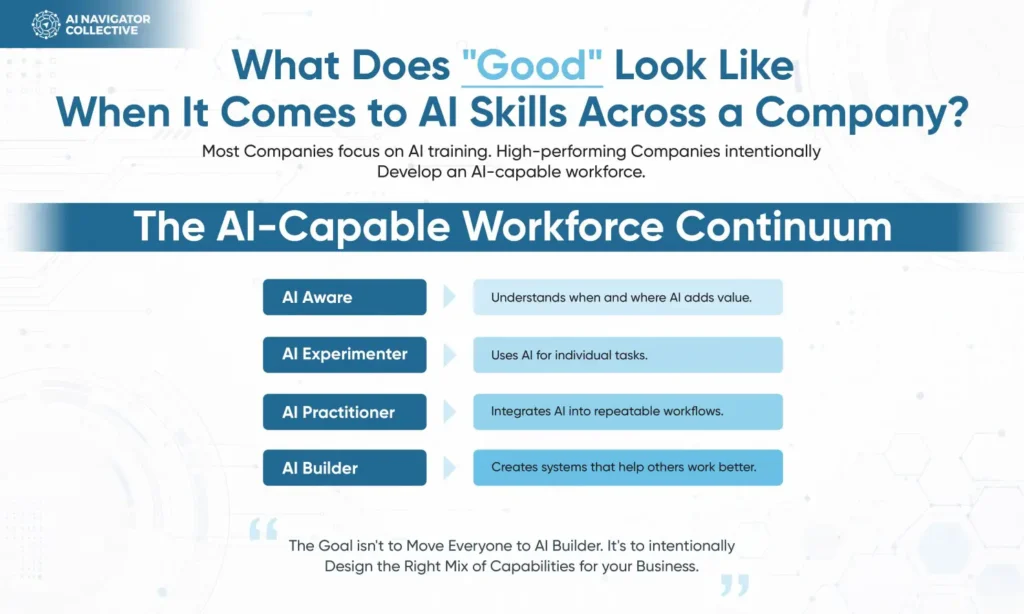
When I think about a workforce capable of leading a business into an AI-driven future, I find it helpful to view employees along a progression. Some are just beginning to understand where AI fits into their work. Others regularly experiment with AI but still use it primarily for one-off tasks. A growing group has begun integrating AI into repeatable workflows that consistently improve quality, speed, or decision-making. Finally, a much smaller group develops automations, reusable systems, and new ways of working that elevate the capabilities of the people around them.
The goal is not to move everyone to the highest level of proficiency. Every organization will require a different mix of capabilities based on its strategy, operating model, industry, and risk profile. A professional services firm, for example, may need a larger percentage of employees embedding AI into client delivery. A manufacturer may concentrate deeper expertise within engineering, operations, or supply chain functions. The right answer depends less on the technology itself than on where AI has the greatest opportunity to create value.
Deloitte’s 2026 State of AI in the Enterprise report reinforces this point. While employee access to AI has expanded rapidly, the greatest challenge remains moving from isolated pilots to company-wide capability. That transition requires redesigning workflows, establishing governance, building confidence, and helping employees understand how AI changes the way their work gets done and what is expected of them.
Organizations don’t build AI capability by teaching everyone the same skills. They build it by developing the right capabilities in the right roles.
This is companies should begin thinking less about AI training plans and more about AI workforce design. Before deciding what courses to offer or what tools to deploy, leaders should understand how work is performed today, where AI can create meaningful value, which roles require deeper capability, and how responsibilities are likely to evolve over the next several years.
That process doesn’t produce a single training curriculum. It produces a workforce strategy.
PwC’s 2026 Global AI Jobs Barometer suggests that AI is making judgment, leadership, and human expertise more valuable, not less. The organizations that create the most value with AI are unlikely to be those with the largest number of AI experts. They will be the organizations that thoughtfully combine technical capability with human judgment and intentionally build the workforce needed to support both.
As AI continues to reshape how organizations operate, I suspect one of the most important questions leadership teams will ask won’t be, “Which AI tools should we use?”
It will be, “What kind of workforce are we trying to build?”
—
If you’re ready to move beyond experimentation and start building an AI-capable organization, let’s talk.
The AI Navigator Collective helps leadership teams identify where AI creates value, prioritize opportunities, redesign workflows, establish governance, and build the internal capability required for sustainable AI transformation.
Schedule a call with our team today to explore what’s possible for your organization.