Your team is likely using AI more than you realize. ChatGPT drafts customer emails, your CRM scores leads automatically, HR software filters job applications before review, and your website chatbot manages inquiries around the clock.
Consider: Who determined these tools were safe to use? What data is shared with them? Who ensures they make fair decisions? Who is responsible if something goes wrong?
These questions are central to AI governance and must be addressed by every business, regardless of size.
Key Takeaways
- AI governance is the set of policies, processes, and oversight mechanisms that guide your organization’s use of AI responsibly, safely, and legally.
- It applies to businesses of every size, including yours, even if you only use third-party AI tools.
- The five core principles are: accountability, transparency, fairness, privacy, and human oversight.
- Key frameworks like the NIST AI Risk Management Framework and OECD AI Principles are free and designed to scale to any organization.
- You can start building AI governance today without a technical team. It begins with a simple inventory and a basic written policy.
What Is AI Governance?
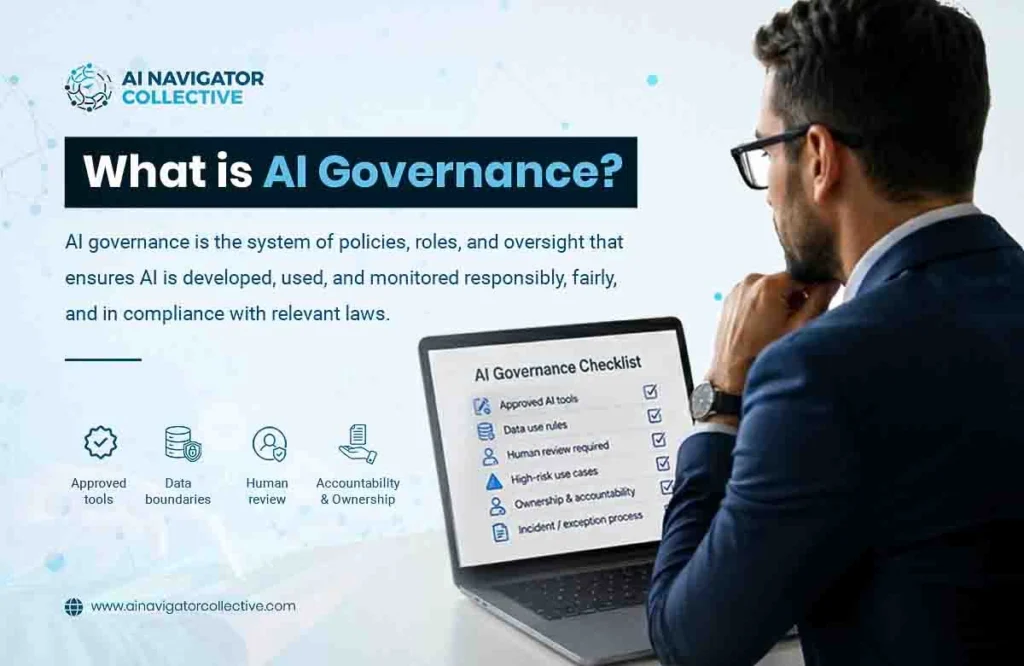
AI governance is the framework of policies, roles, and oversight processes that determines how your business develops, deploys, and monitors artificial intelligence responsibly, fairly, and in compliance with applicable laws.
AI governance should be viewed as a management structure rather than a technical system. Similar to financial governance, which defines spending approvals and audit processes, AI governance establishes who can approve AI tools, how they are monitored, and who is accountable for negative outcomes.
It covers three fundamental questions:
- Who decided to use this AI? (accountability)
- How do we know it’s working the way it should? (transparency and monitoring)
- What happens when something goes wrong? (risk management and responsibility)
AI governance does not limit AI capabilities; it ensures actions can be explained, justified, and corrected. Learn how responsible frameworks shape effective AI governance.
Why AI Governance Matters Especially for Small Businesses?
A common misconception among small businesses is: “This is an enterprise problem. We’re too small for it to apply to us.”
This assumption is incorrect.
The “We’re Too Small for This” Myth
If your business uses any AI-powered tool, you are already making governance decisions, whether intentionally or not. The key question is whether your approach is deliberate or unintentional.
Large companies have legal, compliance, and IT teams to address issues proactively. Small businesses typically do not, making proactive governance even more important for SMBs.
What Happens Without Governance
The risks of operating AI without oversight fall into four clear categories:
- Legal liability. AI tools used in hiring, lending, or pricing can produce biased outcomes that expose your business to discrimination claims. Amazon famously scrapped an internal AI recruiting tool after discovering it systematically downgraded women’s CVs, even though it had hundreds of engineers working on the problem. A small business likely wouldn’t catch the issue at all.
- Data privacy violations. When your team feeds customer data, financial records, or personal information into AI tools, including free consumer tools like ChatGPT, that data may be processed or stored in ways that conflict with GDPR, CCPA, or other applicable laws. Most employees making these decisions aren’t thinking about compliance. They’re thinking about getting work done faster.
- Reputational damage. An AI chatbot providing incorrect information, an automated email with inappropriate content, or an AI tool treating customers unequally can quickly and publicly erode customer trust.
- Shadow AI. This often-overlooked risk involves employees using AI tools without official approval, such as personal ChatGPT accounts, free image generators, or AI writing tools, sometimes entering business or client data into unvetted systems.
AI governance helps organizations use AI responsibly by making decisions easier to explain, justify, and improve when needed. Learn how the right governance framework supports long-term success.
The 5 Core Principles of AI Governance
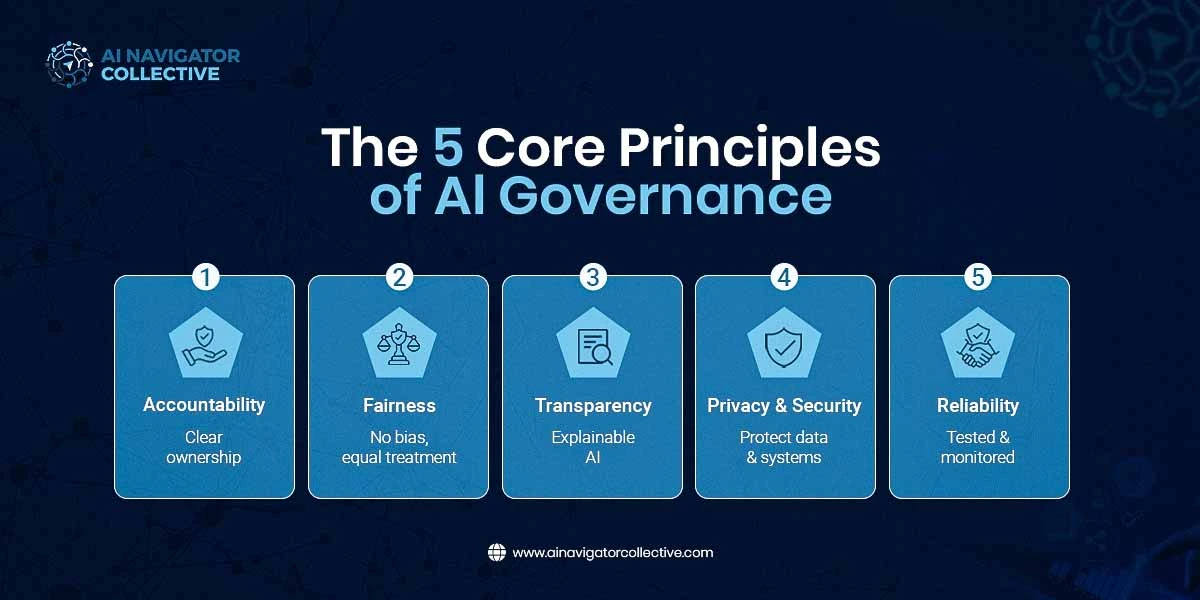
Every major AI governance framework, including NIST, the OECD AI Principles, and the EU AI Act, is built on a shared foundation of core principles. Understanding these principles is the first step in developing your own approach.
1. Accountability
Every AI tool your business uses should have a designated owner, responsible for its deployment and accountable for any issues. This does not require a new hire or department; it may be the operations manager, marketing lead, or business owner.
The key is that accountability is explicit, not assumed. “Everyone is responsible” effectively means no one is.
Practical example: Your customer service chatbot gave a customer incorrect refund information. Who reviews what went wrong and decides how to fix it? That person should be identified before the incident, not after.
2. Transparency
Transparency requires the ability to explain, in general terms, how an AI system makes decisions and why it produces certain outputs. While understanding the underlying code is not necessary, you should be able to explain the logic to customers, regulators, or employees.
Transparency also applies to customers. If AI influences decisions such as loan applications, job screenings, or pricing adjustments, there are growing legal requirements to disclose and, in some cases, explain this involvement.
Practical example: Your AI pricing tool adjusts rates based on demand signals. Can you explain to a customer asking why their quote is higher than a friend’s? Documented logic makes that conversation possible.
3. Fairness
AI systems learn from historical data, and historical data often reflects historical biases. A hiring tool trained on ten years of your company’s recruiting history might unintentionally learn to favor certain demographics if those demographics were historically favored in your hiring decisions.
Fairness in AI governance involves regularly assessing whether AI tools treat all individuals equitably and taking corrective action when they do not. This is especially important for tools impacting employment, access to services, or pricing.
Practical example: Does your AI-assisted hiring screener consistently rank candidates from certain universities or locations higher? That pattern warrants investigation, even if it wasn’t intentional.
4. Privacy and Security
AI tools, including daily software-as-a-service applications, often process, store, and transmit significant data. Governance requires understanding what data each tool handles, where it is stored, who can access it, and whether these practices align with your privacy obligations.
This principle is closely linked to data governance. Before adopting any AI tool, consider: What data does it collect? Where is it stored? Is it used to train the vendor’s models? Does its use require a data processing agreement under GDPR?
Practical example: Your sales team uses an AI tool to record and analyze customer calls. Do your customers know their calls may be analyzed by AI? Is that disclosed in your privacy policy?
5. Human Oversight
AI should support, not replace, human decision-making, particularly for decisions with significant consequences. Human oversight requires that any AI output affecting a person’s life, livelihood, or rights is reviewed and can be overridden by a human.
This is often referred to as the “human-in-the-loop” principle. It is required under certain regulations, such as the EU AI Act for high-risk AI systems, and is considered best practice elsewhere.
Practical example: If your AI tool generates a content brief, a human should edit and approve it before it’s published. If it generates a customer communication, a human should review it before it is sent.
Key AI Governance Frameworks (Explained Without the Jargon)
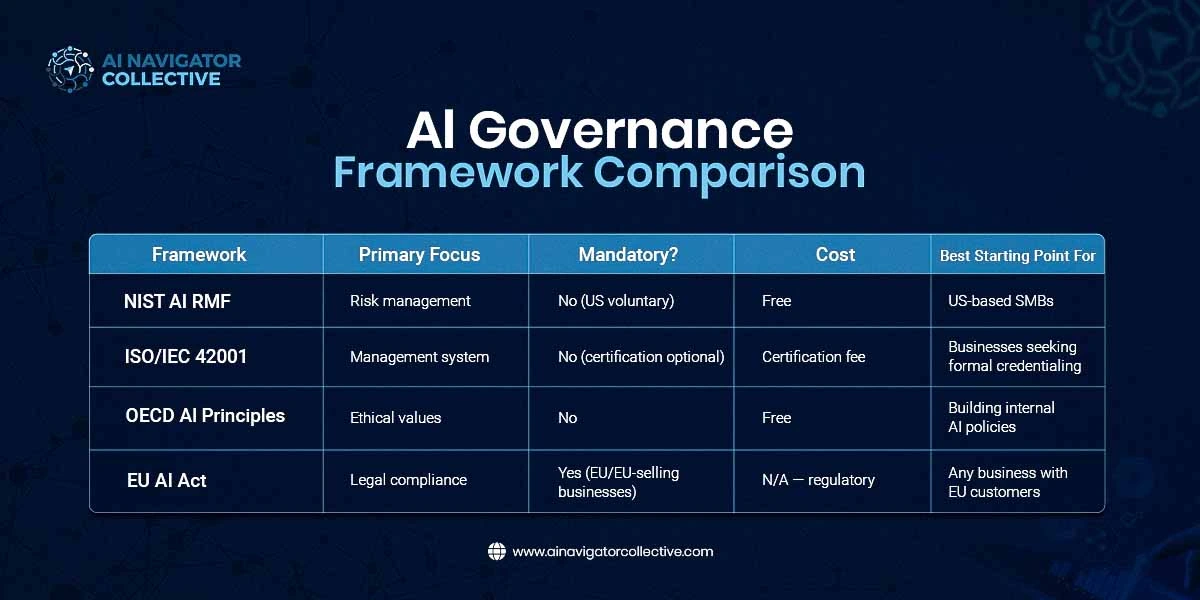
You do not need to select a framework before starting, but understanding available options helps you align with recognized standards. Review how these frameworks compare in practice.
NIST AI Risk Management Framework (AI RMF)
The NIST AI RMF was developed by the US National Institute of Standards and Technology and published in 2023. It’s free, voluntary, and designed to work for organizations of any size or industry.
The framework is organized around four core functions: Govern (establish culture and structure for AI risk management), Map (identify and categorize AI risks), Measure (assess risks), and Manage (prioritize and address them). It serves as a practical, adaptable starting point rather than a rigid checklist.
Best for: US-based businesses that want a widely recognized, scalable framework.
ISO/IEC 42001
ISO/IEC 42001 is the international standard for AI management systems, published in 2023. It follows a similar structure to other ISO management standards (like ISO 27001 for information security) and provides a path to formal certification.
Certification can differentiate your business if you work with enterprise clients, government contracts, or regulated industries that increasingly require suppliers to demonstrate AI governance maturity.
Best for: SMBs that need to demonstrate governance credentials to clients or partners.
OECD AI Principles
The OECD AI Principles are a set of internationally recognized values adopted by 42+ countries, covering five core areas: inclusive growth and wellbeing, human-centered values and fairness, transparency and explainability, robustness and security, and accountability.
These are not a compliance framework but a foundation of values. If you are developing an internal AI policy and wish to align with internationally recognized principles, this is a strong starting point.
Best for: Any organization wanting to establish an ethical baseline.
Framework Comparison at a Glance
| Framework | Primary Focus | Mandatory? | Cost | Best Starting Point For |
| NIST AI RMF | Risk management | No (US voluntary) | Free | US-based SMBs |
| ISO/IEC 42001 | Management system | No (certification optional) | Certification fee | Businesses seeking formal credentialing |
| OECD AI Principles | Ethical values | No | Free | Building internal AI policies |
| EU AI Act | Legal compliance | Yes (EU/EU-selling businesses) | N/A — regulatory | Any business with EU customers |
AI Regulations You Need to Know About
Understanding the regulatory landscape doesn’t require a law degree, but knowing which regulations apply to your business and what they generally require is essential.
The EU AI Act
The EU AI Act is the world’s first comprehensive AI regulation. It classifies AI applications into risk tiers: minimal, limited, high, and unacceptable, and applies requirements proportionate to each risk level.
If you sell products or services to customers in the European Union, this regulation applies to you regardless of where your business is based. High-risk categories include AI used in hiring decisions, credit scoring, access to education, and customer-facing automated decision-making. Unacceptable uses (such as real-time biometric surveillance of the public) are banned entirely.
Penalties for serious violations can reach €35 million or 7% of global annual turnover. Enforcement is phased, with obligations taking full effect through 2026–2027.
Action: Review whether any AI tools you use fall into “high-risk” categories. If you are unsure, consult a legal advisor experienced in EU compliance.
GDPR and CCPA
AI governance and data privacy law overlap significantly. Most AI tools process personal data, which means your obligations under GDPR (for EU data subjects) or the California Consumer Privacy Act continue to apply. Using an AI tool that processes customer or employee data without a proper data processing agreement can be a GDPR violation, even if the AI vendor itself is compliant.
Sector-Specific Rules
If your business operates in healthcare, financial services, insurance, or education, additional AI-specific regulations may apply in your jurisdiction. Regulatory guidance in these sectors is evolving rapidly. Establishing AI governance now positions your business ahead of tightening requirements.
AI Governance vs. AI Ethics: A Quick Clarification
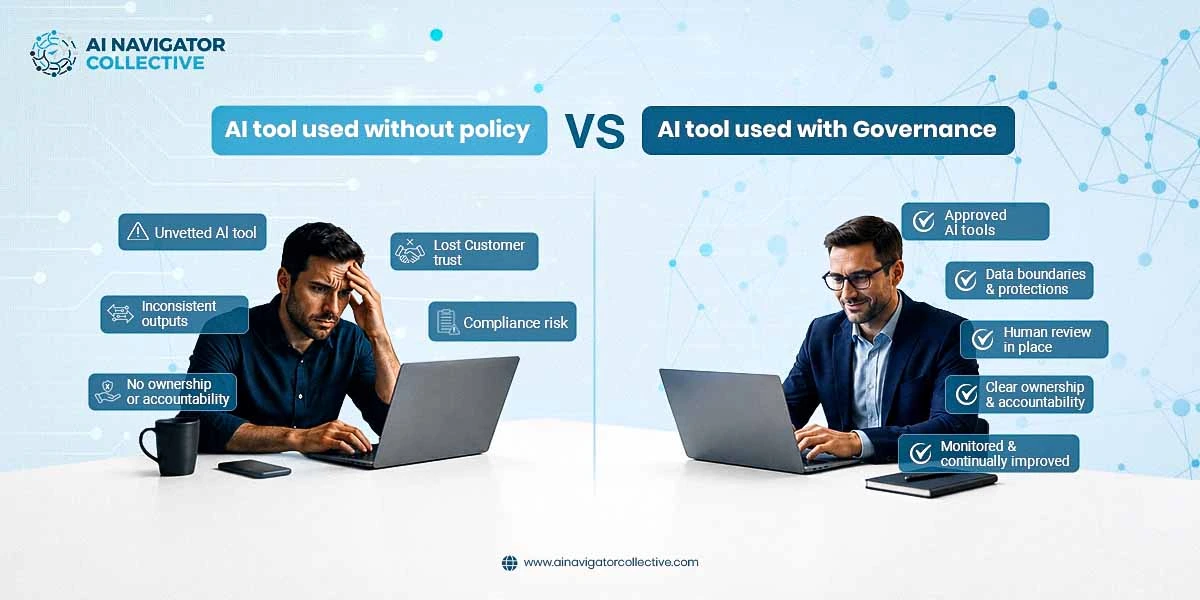
These terms are often used interchangeably, but they refer to different things.
AI ethics concerns the values and principles that should guide the use of AI. What’s fair? What’s right? What do we owe to the people our AI systems affect?
AI governance is about structuring the practical processes, policies, roles, and oversight mechanisms that put those values into practice.
For example, ethics is deciding your business should treat all customers fairly. Governance is establishing the written policy, complaint procedure, staff training, and review process that make fairness real and verifiable.
You need both. But governance is what makes ethics operational. Explore the relationship between ethics and governance in more depth.
How to Build AI Governance in Your Business: 5 Practical Steps
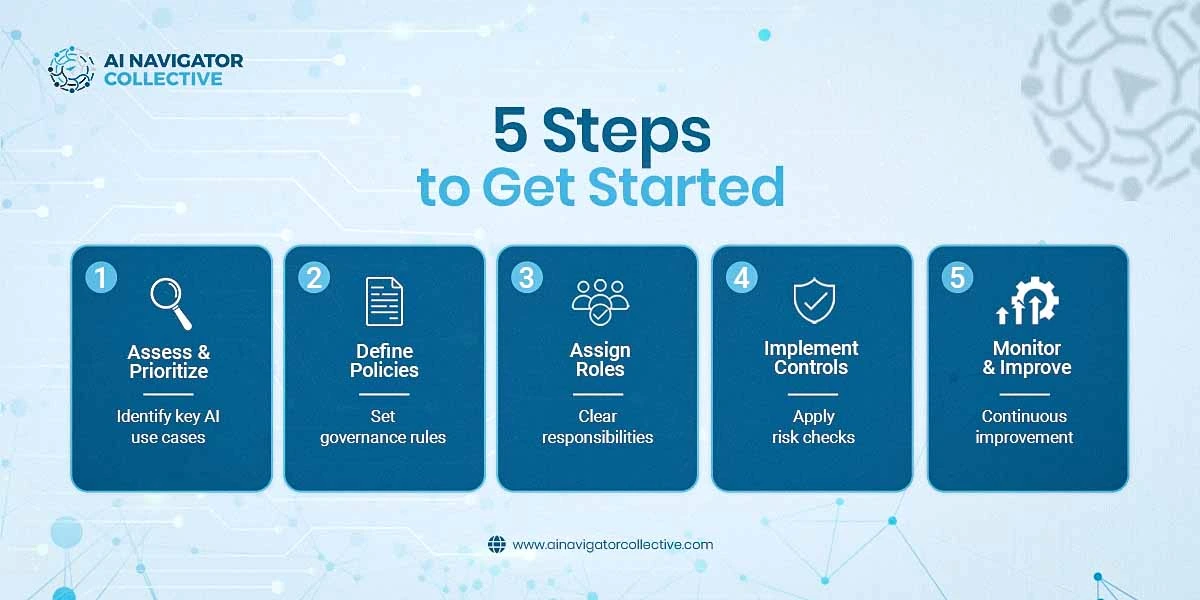
You do not need a data science team, compliance department, or large software budget to begin. These five steps are designed for business owners and managers with small, non-technical teams.
See full best practices and templates for each of these steps.
Step 1: Take Inventory of Every AI Tool You Use
You can’t govern what you don’t know about. Start by listing every AI-powered tool currently in use across your business: your CRM, marketing platform, customer service software, hiring tools, analytics dashboards, and any consumer AI tools your team uses personally (ChatGPT, Copilot, Gemini, image generators, etc.).
Do not exclude tools based on whether you believe they “count.” If a tool uses machine learning or AI to make recommendations, generate content, score data, or automate decisions, include it in your inventory.
Step 2: Assign an Owner to Each Tool
For each tool on your list, designate one named person who is responsible for how it’s used and accountable if it causes a problem. This is often the person who requested or manages the tool: a marketing manager for a content AI tool, an HR manager for a hiring screener.
Ownership does not require technical expertise. It means being responsible for understanding the tool’s capabilities, limitations, and appropriate use, and for raising concerns when issues arise.
Step 3: Write a Simple AI Use Policy
Your AI policy does not need to be lengthy. A one- to two-page document covering the following points is a meaningful start:
- Which AI tools are approved for business use
- What types of data can and cannot be entered into AI tools (customer personal data, financial information, confidential business information)
- How AI-generated content must be reviewed before it’s published or sent
- Who approves the adoption of new AI tools
- Who to contact if an AI tool behaves unexpectedly or produces a concerning output
Browse real-world AI governance policy examples for inspiration
Step 4: Apply Extra Scrutiny to High-Impact Tools
Identify any AI tools in your inventory that influence decisions related to hiring, customer pricing, credit or lending, or medical recommendations. These tools carry the highest legal and ethical risk and require additional scrutiny:
- Has the vendor published documentation on bias testing or fairness audits?
- Is a human reviewing AI outputs before they’re acted upon?
- Do customers or applicants know AI is involved in decisions that affect them?
- Is this tool classified as “high-risk” under the EU AI Act?
Step 5: Schedule a Quarterly Review
AI tools update frequently, regulations evolve, and team usage patterns change. Schedule a quarterly review to assess your AI inventory, identify new regulatory requirements, and update your policy as needed.
Governance isn’t a one-time Governance is not a one-time project; it is an ongoing practice. Quarterly reviews help keep it manageable.
Common Challenges (and How to Get Past Them)
“We don’t have time for this.” Start small. An inventory list and a one-page policy can be created in a few hours. Governance does not need to be comprehensive initially; it should exist and improve over time.
“Our tools are off-the-shelf; isn’t the vendor responsible?” Partially. Vendors are responsible for building their AI. You are responsible for how you deploy it, the data you provide, and the decisions you make based on its outputs. Governance helps manage this shared responsibility.
“We’re not technical enough.” AI governance is primarily a management and organizational challenge, not a technical one. Key questions about accountability, data usage, and error handling are business, not engineering, concerns.
The Future of AI Governance
The governance landscape is evolving rapidly and directly impacts small businesses that perform autonomous actions, such as booking meetings, sending emails, or placing orders, are becoming mainstream. As AI shifts from answering questions to taking actions, governance requirements must adapt.
Enterprise procurement processes increasingly require AI governance assessments. If your business sells to larger companies or public sector organizations, you will likely need to demonstrate your AI governance practices within the next two to three years.
Regulatory expansion is accelerating worldwide. Similar frameworks are expected to follow the EU AI Act in other jurisdictions. Establishing governance practices now will ease adaptation to new requirements and minimize disruption.
Businesses that view AI governance as an early investment, rather than a compliance burden, will gain a significant advantage as regulatory and competitive landscapes evolve.
Frequently Asked Questions
Is AI governance only for large companies?
No. Any organization using AI tools benefits from governance; the scale just needs to match the size and risk of your AI use. A small business using ChatGPT to draft emails has simpler governance needs than a company using AI to make automated credit decisions, but both require some governance.
What is shadow AI, and why does it matter?
Shadow AI refers to AI tools that employees use without official approval or IT awareness, often free consumer tools. The risk is that sensitive business or customer data may be entered into unvetted systems, creating privacy, security, or compliance exposure. Governance helps prevent this by defining which tools are approved and why.
Does the EU AI Act apply to my small business?
If your business operates in the EU or sells products and services to EU customers, yes, the EU AI Act applies based on where your customers are located, not where you are based. Compliance obligations are proportionate to risk level, meaning lower-risk AI uses have lighter requirements.
What’s the difference between AI governance and data governance?
Data governance focuses on how your organization manages and protects data. AI governance is broader; it covers how AI systems are designed, deployed, and monitored, including (but not limited to) how they use data. The two disciplines overlap significantly and should be developed in parallel.
Do I need to hire someone specifically to manage AI governance?
Not at the SMB level, at least not initially. Governance responsibilities can be distributed across existing roles assigned to operations, HR, or the business owner directly. As your AI use grows and regulations tighten, a dedicated governance role or committee may become worthwhile.
What is an AI use policy?
An AI use policy is a written document that defines the rules and expectations for how employees in your organization use AI tools. It typically covers which tools are approved, what data can be used with AI systems, how AI outputs should be reviewed, and how incidents should be reported.
How is AI governance different from AI ethics?
AI ethics defines the values that should guide us:e fairness, transparency, and accountability. AI governance is the practical implementation of those values through policies, processes, and oversight mechanisms. Ethics tells you what you should do; governance is the structure that ensures you actually do it.
Conclusion
AI governance is not a regulatory checkbox or an enterprise luxury. It’s the practical answer to one of the most important questions in modern business: Who is responsible when the AI gets it wrong?
For small businesses, governance does not need to begin as a comprehensive compliance program. It should start as a habit: knowing what AI you use, who is responsible for it, what data it handles, and how you will respond to harmful outputs. Building and regularly reviewing this foundation distinguishes businesses that use AI confidently from those that do so with uncertainty.
The tools are accessible. The frameworks are free. The first steps are achievable this week.
Want to go deeper? Explore our related guides:
- AI Governance Framework: Which One Is Right for Your Business?
- AI Governance Policy Examples You Can Adapt
- How to Build an AI Governance Committee
- AI Decision-Making Framework for Business Leaders