
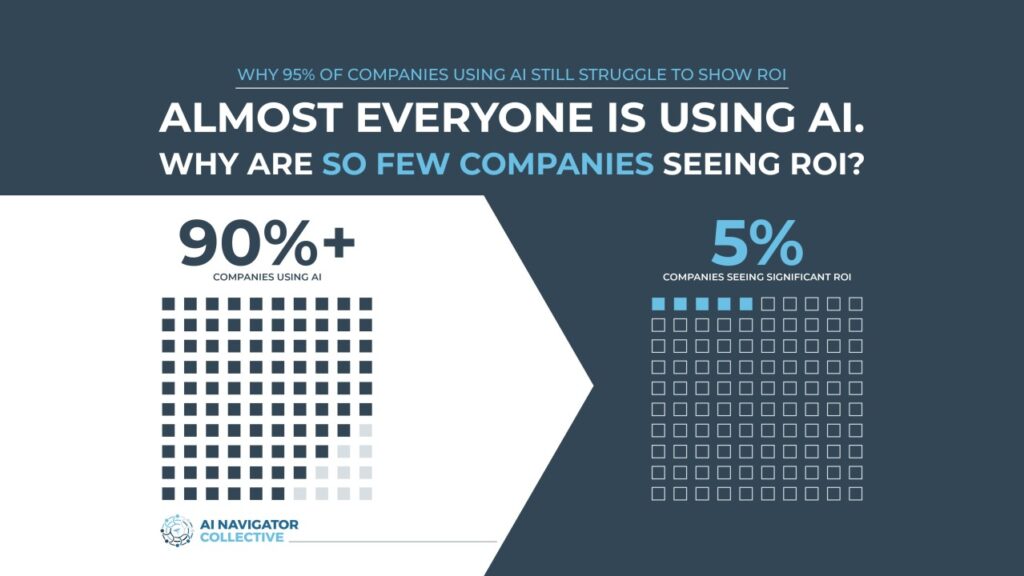
By most measures, AI adoption is no longer the question. McKinsey recently reported 78% adoption in 2024 and 88% in 2025, and other studies place the number above 90%. Analysis from MIT’s Project NANDA last summer finds that of the 90%+ of businesses ‘adopting’ AI, only about 5% appear to be producing significant value or measurable ROI.
When you zoom into the companies who can see a measurable ROI from their AI usage, you find out that much of that value is concentrated in a small number of companies. PwC’s 2026 AI Performance Study, which surveyed 1,217 executives across 25 industries, found that 74% of all AI-generated economic value is concentrated in only 20% of those companies.
If nearly everyone is adopting AI, why are so few companies seeing a meaningful impact?
These studies fuel my curiosity. The question I’m asking: What is the difference between the companies creating outsized results versus those who are struggling to see even a small ROI?
The answer I’m seeing is that the organizations creating disproportionate value are doing something fundamentally different.
They have built an AI Strategy and the internal capability to operationalize it coherently. They are redesigning workflows rather than simply adding tools. They concentrate investment on a handful of high-value use cases. They establish governance and clear decision rights. They assign executive ownership. They integrate AI into operating models. They use AI for growth and business model reinvention; any efficiencies they gain are just a bonus.
PwC’s April 2026 study found that when companies approach AI in this way, they see more than seven times the financial returns compared with their peers.
So, how do you, as a business leader, actually make this shift inside your company?
Where can AI create measurable value? How long will it take to realize that value, and how should it be measured? Which workflows should change? What decisions should remain human-led? Where should AI augment work versus automate it? What governance structures are needed to remain safe and responsible? Who owns prioritization and implementation? And maybe most importantly, where do you start?
Those are the questions that led the AI Navigator Collective to create its AI Strategy Accelerator program. Over three months, we work with your team to identify where AI can create value, prioritize opportunities, establish governance, and build a practical roadmap for implementation. By the end, you’ll have clarity around where you are headed, what matters most, and how AI fits into the way work actually gets done.
—
If you’re ready to move beyond experimentation and start building an AI-capable organization, let’s talk.
The AI Navigator Collective helps leadership teams identify where AI creates value, prioritize opportunities, redesign workflows, establish governance, and build the internal capability required for sustainable AI transformation.
Schedule a call with our team today to explore what’s possible for your organization.