
Leaders everywhere are racing to adopt AI. Budgets are increasing, new tools are being introduced weekly, and teams are experimenting faster than ever before. Yet despite the surge in investment, most organizations still struggle to create measurable business outcomes from AI. Deloitte’s State of Generative AI report for 2026 shows many AI initiatives remain stuck in pilot stages, failing to scale into organization-wide transformation.
When you dig into the difference between the companies who can name ROI from their AI usage vs. those who cannot, the difference isn’t about who has the most or best tools, it’s about strategy. Companies who will ultimately create long-term advantage with AI are focused on building the organizational capability to continuously integrate AI into how work actually happens.
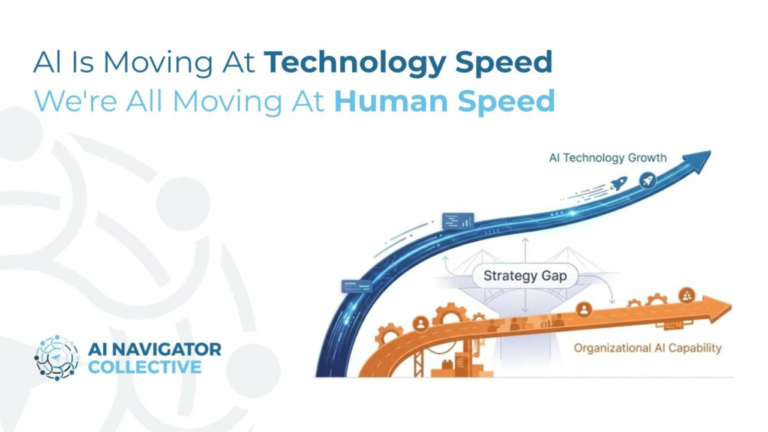
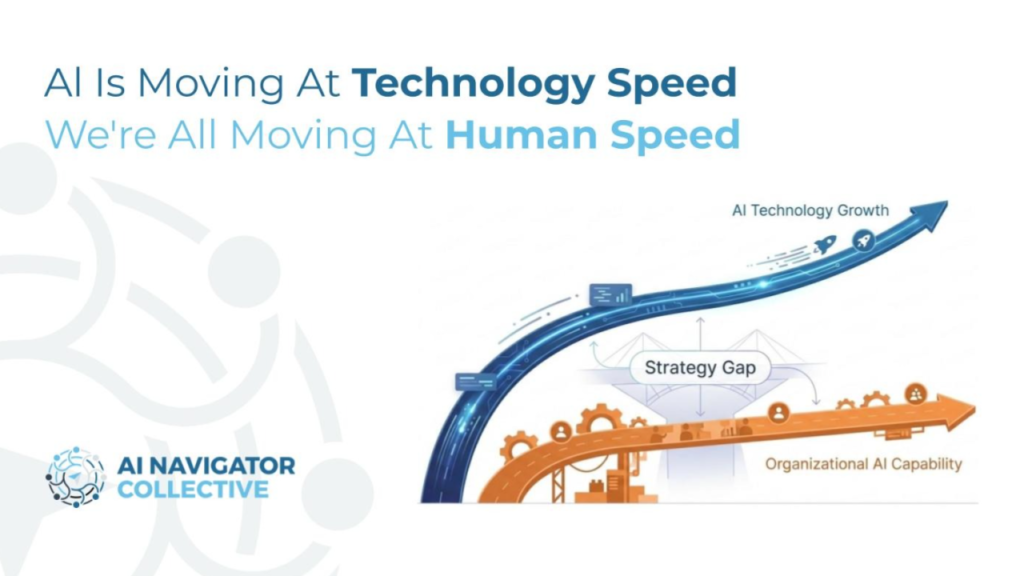
This gap between technological acceleration and organizational adaptation is becoming one of the defining business challenges of our time. Right now, AI is evolving at technology speed while organizations move at human speed.
Models improve constantly. New capabilities emerge every few months. Entire categories of work are being reshaped in real time. Meanwhile, leadership alignment takes time. Governance takes time. Workflow redesign takes time. Getting cross-departmental agreement on anything takes time.
This gap is where many companies are getting stuck. Activity is increasing, but capability is not. New tools are layered onto fragmented workflows. Teams experiment independently. Pilots emerge across departments. Spending increases. But measurable operational transformation remains limited.
The issue usually isn’t the technology itself. It’s that organizations are trying to integrate AI into workflows, decision structures, and operating models that were never designed for it in the first place.
Real AI value comes from asking the question “Where can AI create value in our business, and on what time horizon?”
Then redesigning how work moves through the organization based on the answer. This includes:
- redefining workflows
- clarifying ownership and governance
- redesigning handoffs and approvals
- determining where human judgment matters most
- building internal leadership capability
- creating systems for continuous learning and adaptation
AI transformation is fundamentally an organizational challenge, not just a technical one. The organizations creating sustainable advantage are building capability that compounds over time.
AI strategy will become the biggest divide in the market over the next few years.
Not between companies that have AI and companies that don’t.
But between companies that built the internal capability to continuously identify and deploy AI across their business in ways that create real value, and the companies who’ve spent years accumulating tools.
If you’re ready to move beyond experimentation and start building an AI-capable organization, let’s talk.
The AI Navigator Collective helps leadership teams identify where AI creates value, prioritize opportunities, redesign workflows, establish governance, and build the internal capability required for sustainable AI transformation.
Schedule a call with our team today to explore what’s possible for your organization.