
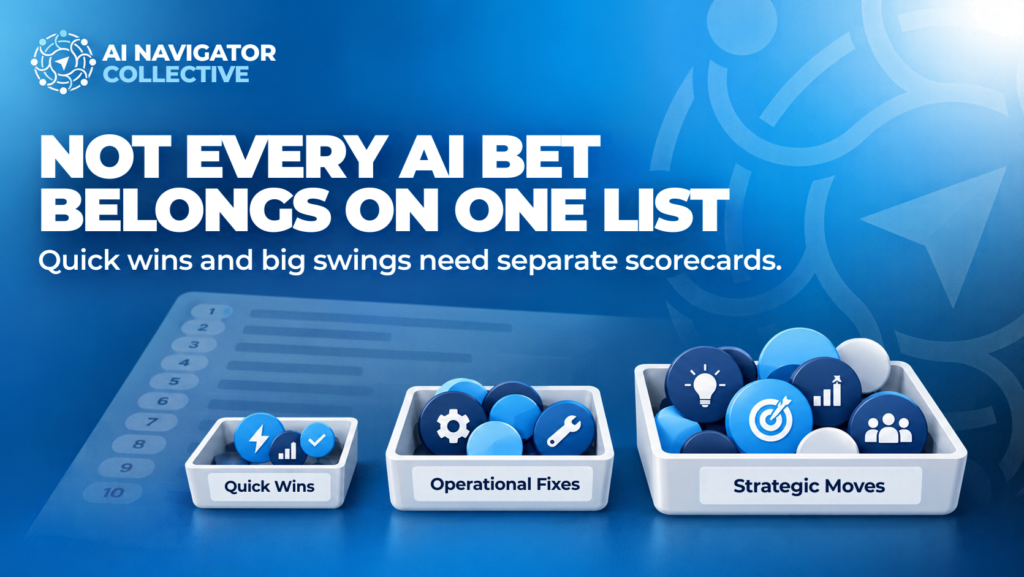
If your team has a list of AI ideas worth pursuing, it’s worth thinking about the value each one has on the business’ strategic goals and growth. Understanding impact, growth, alignment to goals, cost, and risk can help you distinguish between what efforts are worth the ROI. At the AI Navigator Collective – we think about AI Value in three categories: Quick Wins, Operational Enhancements, and Strategic Moves. When you categorize your AI possibilities across these three realms – you quickly notice that these aren’t the same kind of bets. One might pay off next month. The other might take a year and carry the potential to completely change how your company competes in its industry, with some risk of course. We covered what to do with freed-up AI capacity in Four Companies, Four Different Ways AI Hit Their Bottom Line, and went deep on IKEA’s version of that decision in the previous article in this series. This one is about AI opportunity prioritization, the mistake that happens even earlier: treating every AI idea as if it belongs in the same category. Read on for real examples of each.
Radisson: A quick win that didn’t need a new business model
Radisson Hotel Group used Google’s AI tools to automate ad creation, translation, and localization across markets and languages. The results were fast and concrete: a 22 percent increase in ad-driven revenue and a 35 percent increase in return on ad spend, with ad copy that used to take up to eight weeks now turning around in hours. Radisson didn’t reinvent anything. It made an existing workflow faster. The payoff showed up quickly, and the investment and risk were both low.
Walmart: A catalog fix at a scale no team could do by hand
Walmart used generative AI to create or improve more than 850 million pieces of data in its product catalog, a project CEO Doug McMillon said on the company’s Q2 fiscal 2025 earnings call would have needed nearly 100 times the current headcount to do by hand.
Mercado Libre: Fraud detection sharpened to nearly 99 percent
Mercado Libre uses GPT-4 to evaluate data across millions of product listings daily, pushing fraud detection accuracy on flagged items to nearly 99 percent. Fraud review isn’t new at Mercado Libre. What changed is how much of it a machine can now catch.
DoorDash: Routine driver calls handled without a human
DoorDash built a voice-activated support system for delivery drivers that cut the calls needing a live agent by 49 percent, worth roughly $3 million a year in savings. DoorDash still isn’t doing anything it wasn’t doing before. It’s just using AI to do it more efficiently.
UPS: Customs clearance scaled ninefold overnight
UPS used agentic AI to scale the share of daily U.S. package volume it clears through customs without manual review from roughly 21 percent to 90 percent after a regulatory change eliminated a longstanding customs exemption, absorbing nearly nine times the shipment volume in the process. UPS clears customs the same way it always has — just nine times faster without a person checking each shipment.
IKEA: The reskilling bet that built a new revenue line
Strategic moves are a different category of bet entirely. IKEA’s reskilling of 8,500 call center employees into remote design consultants, covered in depth in the piece just before this one, created a new revenue channel that didn’t exist before, reportedly worth around $1.4 billion in a single fiscal year. That’s not an enhancement to an existing process. It’s a new one.
Octopus Energy: An internal tool that became a $500 million business
Octopus Energy’s Kraken platform started as an internal tool to run Octopus’s own operations, and then grew into a licensing business that reached $500 million in committed annual revenue, enough that Octopus spun it off as an independent company. Both IKEA and Kraken took a year or more, carried real risk, and didn’t happen by accident. Someone had to notice the capability was bigger than its original purpose.
How This Applies to You
The point isn’t ranking these bets against each other. Radisson should be measured against other quick wins, Walmart and UPS against other operational fixes, IKEA and Kraken against other strategic bets, not all seven on one spreadsheet. A reasonable portfolio for most mid-sized organizations leans heavily toward quick wins early on, layers in a smaller number of operational enhancements as the team builds confidence, and treats strategic moves as occasional, carefully considered bets rather than something attempted constantly. Running your AI program entirely on strategic moves is a good way to burn a year and a budget with nothing to show for it. Stick to quick wins only, and you’ll never take the swing that actually changes the business.
Access our full library of free and low-cost training resources → https://ainavigatorcollective.com/resourcefinder/
Want to Learn More?
- Four Companies, Four Different Ways AI Hit Their Bottom Line
- IKEA’s $1.4 Billion Chatbot Was Actually a Workforce Strategy
- AI Doesn’t Transform Companies. Workflow Redesign Does.
FAQ
How do you prioritize multiple projects?
For AI specifically, you don’t actually prioritize these against each other on one list. A quick win, an operational enhancement, and a strategic move aren’t competing for the same slot. They move on different timelines and carry different amounts of risk. The useful version of this question is really three questions: how many quick wins can run at once (several, since they’re low-cost and low-risk), how many operational enhancements (one or two, given the coordination they require), and how many strategic moves (rarely more than one being actively built, since it demands sustained leadership attention). For a step-by-step way to rank which problem gets AI help first, see AI Decision-Making Framework for Business: From Strategy to Execution.
Should every company eventually attempt a strategic move?
Not on any fixed timeline. Strategic moves make sense when a capability the company already built for internal use turns out to have value beyond its original purpose, the way Kraken did for Octopus Energy. Forcing one before that signal shows up usually means chasing a trend rather than following actual evidence. For more on why capability, not tools, is what compounds over time, see AI Capability Is the New Competitive Advantage.
What’s the risk of only ever doing quick wins?
The value caps out low. Quick wins are real and worth doing, but they rarely change the trajectory of a business on their own. A portfolio of nothing but quick wins tends to produce a lot of small, real efficiency gains and no transformation. For what happens when AI activity grows but strategy doesn’t, see Most Companies Don’t Have an AI Strategy. They Have AI Usage.
Does a small business need to think about this, or is it overkill?
This scales down fine. A five-person business might be running two low-risk ideas, one moderate-investment project, and not touching a high-stakes bet at all. That’s a completely reasonable mix for that size. Separating ideas this way is proportional, not tied to company size.