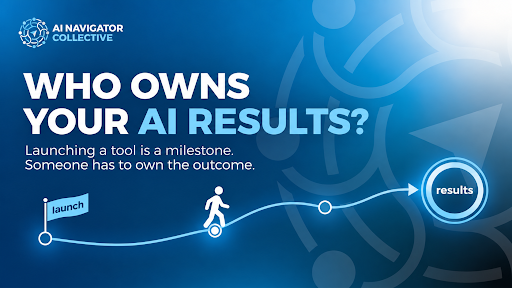
Launching an AI tool is a milestone, but it doesn’t tell you whether or not an investment paid off, work improved, or if strategic goals are being met better. Getting a meaningful business result or ROI takes someone who can identify a problem worth solving, bring the affected teams into the work, determine the best AI-driven process and tool for the outcome, and measure what actually improves. This all starts with understanding where AI could create the most value in a business, and then making those opportunities real across teams.
Four Companies, Four Different Ways AI Hit Their Bottom Line covered what happens after AI frees up time, the IKEA piece went deep on one company’s version of that decision, and the piece on ranking AI ideas covered the mistake of scoring every idea the same way. Look closely at all three and the same pattern shows up: someone had to own the cross-functional coordination required for the results to happen.
Walmart: A catalog project that touched four departments at once
Walmart uses AI to improve the information in its enormous product catalog. A missing or inaccurate detail can make it harder for a customer to find the right item, so Walmart built quality checks into the way AI updates that information. The goal reaches beyond producing product descriptions faster: the data has to be reliable enough to improve the shopping experience. That requires someone to keep the customer outcome in view while the technology and the people responsible for product information do their work.
UPS: A regulatory deadline that forced three teams to move together
Customs clearance involves trade rules, shipment data, documentation, and people who know how to handle exceptions. UPS is combining AI with its brokerage expertise to help customers navigate those requirements and move shipments through the process. The measure of success is not simply how much paperwork AI can process. It is whether shipments clear reliably and customers get the service they need. That means connecting the technology work to the people and decisions that shape the clearance process.
IKEA: A workforce shift that needed HR, training, and sales aligned
Ingka Group, the largest IKEA retailer, introduced its Billie chatbot to handle simpler customer inquiries. It also reskilled 8,500 call center staff to handle interior design, sales, and more complex customer needs. The chatbot changed the workload, but people still had to decide what employees would do next and how to prepare them for it. That connection between automation, employee skills, and customer experience is where the larger business opportunity lay.
How This Applies to You
A department can run a useful AI pilot on its own. But when the opportunity changes how other teams work, someone needs to bring those teams into the decisions. Who is choosing which problems are worth solving? Who can help redesign the workflow, work through changes to people’s roles, and check whether the investment is producing the intended result?
That responsibility might sit with an internal leader supported by a small team. In a smaller company, an advisor or fractional AI leader could help provide the same strategic direction and coordination. The title matters less than making the responsibility clear—and giving that person the access and support to see the work through beyond the pilot.
Not sure where to start? Reach out to the team at AI Navigator Collective, we can help.
Access our full library of free and low-cost training resources → https://ainavigatorcollective.com/resourcefinder/
Want to Learn More?
- Four Companies, Four Different Ways AI Hit Their Bottom Line
- IKEA’s $1.4 Billion Chatbot Was Actually a Workforce Strategy
- A Quick Ad Fix and a $500 Million Spinoff Aren’t the Same Kind of AI Bet
FAQ
Is Chief AI Officer a real role?
It’s a fast-growing one, though the title varies (Chief AI Officer, VP of AI, Head of AI Transformation). The title matters less than whether one person actually has authority over problem selection, workflow redesign, and workforce changes. Without that authority, the title is decorative, whether it’s full-time or fractional.
How much does a Chief AI Officer make?
Full-time compensation for the role sits well into six figures at companies large enough to justify a dedicated executive seat, often comparable to other C-suite functions. That cost is exactly why a fractional Chief AI Officer exists. It gives a company the same accountability and cross-functional authority without paying for a full-time seat.
What’s the difference between an AI project manager and this kind of ownership?
A project manager typically owns getting the tool implemented on schedule and within budget. This kind of ownership goes further. It includes the authority to redesign workflows, change roles and incentives, and stay accountable for the business result long after the technical rollout is finished.
Is a fractional Chief AI Officer only useful for a project as large as IKEA’s reskilling program?
No. The role is about ownership and coordination, which matters at any scale where an AI initiative touches more than one team or requires a workforce decision. A ten-person company automating its intake and quoting process still benefits from having one person making sure that automation changes how the team actually works, and doesn’t just swap out the software.
What happens if a company just lets departments run their own AI pilots independently?
Some of those pilots work fine within their own boundaries. Very few produce the kind of company-wide result seen in the examples throughout this series, because that scale of result consistently required decisions no single department was positioned to make on its own.