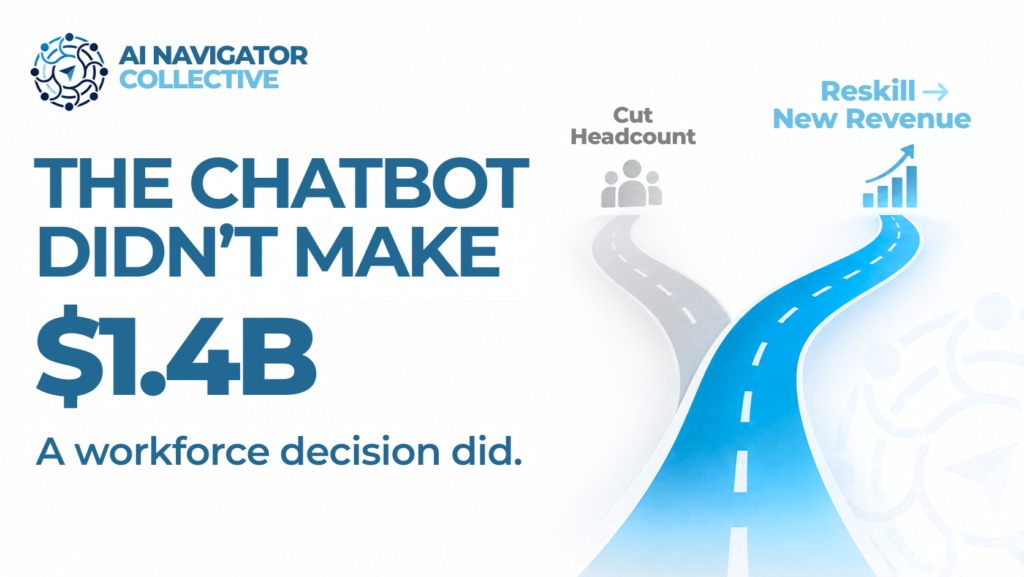
IKEA’s chatbot, Billie, now resolves about 47 percent of customer service inquiries on its own. That’s the boring part of the story. The interesting part is what Ingka Group, IKEA’s largest retailer, did with the 8,500 call center employees whose workload Billie took over. That choice turned into a remote sales channel reportedly worth $1.4 billion (€1.3 billion in Ingka’s 2022 fiscal year) in a single year. We covered the broader pattern behind this in Four Companies, Four Different Ways AI Hit Their Bottom Line: AI frees up capacity, and that capacity only becomes value once someone decides what it’s for. IKEA is one of the clearest examples of an AI workforce strategy done well.
IKEA’s Workforce Strategy: What Happened
Billie was built to handle routine and repetitive customer inquiries like order status, delivery windows, and return policies. These are the kinds of questions that don’t need human judgment to answer well. It succeeded at that job, eventually resolving close to half of all incoming customer contacts.
That left a real question sitting on the table. IKEA had thousands of call center employees whose workload had just dropped. The company could have reduced headcount and booked the savings, the default move most organizations make in this exact spot. Instead, IKEA noticed something in the calls Billie couldn’t handle. Customers weren’t just asking where their package was. They were asking for help picking a sofa, planning a small room, or choosing between two similar dining sets. Really, that’s a sales conversation, and one the employee could easily have.
The company retrained 8,500 of those employees as remote interior design consultants and digital sales advisors, building on customer service skills they already had and layering in new training in interior design, digital retail sales, and relationship building. The new channel that resulted became one of IKEA’s fastest-growing sales lines.
How This Applies to You
IKEA’s AI wins aren’t unique to companies with 8,500 employees. A five-person support team whose ticket volume drops 40 percent after adding an AI assistant faces the same choice. The numbers are smaller, but you’re facing the same decision IKEA did – how do you leverage AI to free up time for your workforce to focus on higher-value workloads.
Access our full library of free and low-cost training resources → https://ainavigatorcollective.com/resourcefinder/
Want to Learn More?
- Four Companies, Four Different Ways AI Hit Their Bottom Line
- What Does ‘Good’ Look Like When It Comes to AI Skills Across a Company?
- AI Doesn’t Transform Companies. Workflow Redesign Does.
FAQ
Did IKEA avoid layoffs because of Billie?
The 8,500 employees whose workload changed because of Billie were reskilled rather than let go. Ingka Group and its parent company have made separate workforce reductions since, in unrelated parts of the business, a reminder that one well-run reskilling program doesn’t make a company immune to broader business decisions elsewhere.
Is the $1.4 billion figure the profit from the chatbot?
No. The figure describes revenue generated by the new remote design consultation and sales channel that reskilled employees now staff, not savings from the chatbot itself. The chatbot’s contribution was freeing up the capacity that made the new channel possible.
Which 3 jobs will not survive AI?
That’s really the wrong question to ask about a case like IKEA’s. Billie didn’t eliminate a job title, but rather a slice of one. Specifically, it replaced the routine, repeatable share of a call center role. What happens to the rest of that job, and to the person doing it, comes down to a call leadership makes, not something the technology decides on its own. IKEA’s answer was that the task of resolving basic tickets went away, but the people who used to do it didn’t.
What jobs will be eliminated by AI by 2030?
The honest answer is fewer whole jobs and more individual tasks. Billie replaced a set of tasks inside a role, checking on an order, confirming a delivery window, walking someone through a return, not the role itself. The more useful question for a business owner isn’t which tasks inside a job disappear, it’s what happens to the person who used to do them.
What 5 jobs will survive AI?
Roles built around judgment, rapport, persuasion, and creative problem-solving tend to survive and grow once the routine work around them gets automated. That’s exactly what IKEA’s reskilled employees ended up doing by focusing on design and consultative selling work an algorithm can’t replicate.