Your Company Is Saving Time With AI. Now What?
If your employees are using AI, there’s a good chance they’re getting some of their work done faster. Maybe they’re spending less time writing emails, preparing reports, or responding to customer questions. That’s great, but there’s something we’re not talking about enough: What actually happens to all the time we’re saving?
Let’s say your team saves 10 hours a week using AI. Are you serving more customers, taking on additional work, or improving the quality of what you deliver? Or is everyone simply moving on to the next thing on their to-do list?
We’ve spent the last few years encouraging businesses to adopt AI and find ways to work more efficiently. Now we need to start asking what those productivity improvements are actually doing for the business.
We recently came across three examples from Wipro, Mercy, and Wayfair that illustrate this really well. What interested us was the recognition of AI as a leadership skill first and a software purchase second, and the intentionality behind how they translated saved time into business impact.
Wipro: What Happens When AI Frees Up Your People?
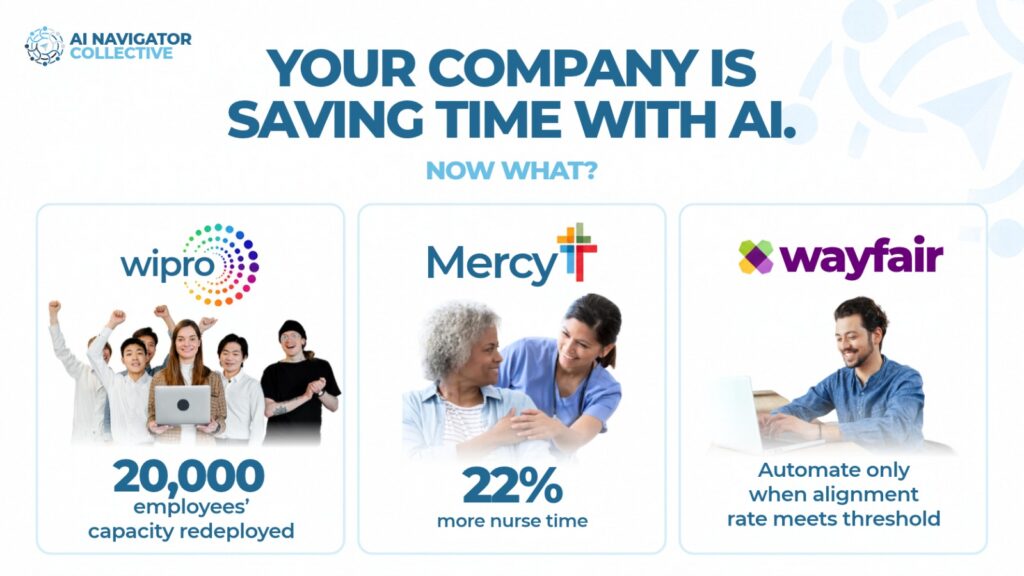
Wipro, one of India’s largest IT services companies, recently reported that AI had created capacity equivalent to the work of 20,000 employees. With all the conversation about AI replacing jobs, you might assume that meant thousands of layoffs. But according to Wipro, the company chose to redeploy employees into other work instead.
As Reuters reported, Wipro has been moving employees into new projects, helping them learn to manage AI agents, and investing in training for new roles.
It’s worth noting that the 20,000 figure represents estimated capacity, not a confirmed financial return. But the leadership decision is still interesting. Wipro is looking at how to put that additional capacity to work rather than treating productivity improvements solely as an opportunity to reduce headcount.
Most of us aren’t running companies with hundreds of thousands of employees, but the same question applies to a business with 20 or 50 people. If AI helps your team finish work faster, where could you put that additional capacity to better use?
Mercy: Giving Employees Time Back for What Matters
Mercy, a healthcare system with more than 50 hospitals, introduced Microsoft’s Dragon Copilot to help nurses spend less time documenting patient care.
In the first 12 weeks, flowsheet documentation time per shift dropped 22%. But here’s the result that caught my attention: Patient-rated nurse communication scores increased 20%.
These are early results from the initial rollout, but they demonstrate why Mercy’s approach is worth studying. The organization wasn’t simply trying to make documentation faster. It wanted nurses to spend more time focused on patients, and it designed the implementation around that goal.
Think about what that could mean in your business. If your customer service team spends less time answering routine questions, could they build stronger relationships with customers? If your salespeople spend less time preparing proposals, could they spend more time developing new business?
Mercy knew what it wanted employees to do with the time they got back. Do you?
Wayfair: Knowing When to Give AI More Responsibility
Wayfair offers a slightly different lesson. The online retailer has used AI to correct 2.5 million product tags and now automates approximately 41,000 supplier support tickets per month.
But what we found most interesting in OpenAI’s case study was how Wayfair decides when AI is ready to work more independently. The company measures how often AI recommendations match decisions made by human employees. When performance consistently meets an established threshold, certain workflows can move toward greater automation.
That’s an important distinction. Wayfair isn’t simply giving AI more responsibility because the technology is available. It’s measuring whether the technology is reliable enough to handle the work.
For smaller businesses, where one mistake can damage a customer relationship, this matters. The goal isn’t to remove people from every process. It’s to figure out where AI can reliably do the work and where human judgment is still needed.
How This Applies to You
You don’t need to be Wipro, Mercy, or Wayfair to learn something from these examples. Wipro had to decide what to do with its people. Mercy had to decide how employees should use their time. Wayfair had to decide how much responsibility AI should have.
What connects them is that their leaders were thinking about how AI should change the business, not just which tools to introduce.
If you’re already using AI, here’s something we’d encourage you to do this week. Pick one workflow where your team is saving time and ask what that additional capacity is actually accomplishing. Are you reducing costs, serving more customers, improving quality, or creating opportunities for growth?
You may discover that you’re getting more value than you realized. Or you may find that the time savings haven’t translated into meaningful business improvements yet.
Either way, it’s worth knowing. Because the goal was never just to finish work faster. It was to build a better business.
Want to get more value from AI? Explore our free and low-cost AI training resources to help your team build practical skills and put them to work.
Want to Learn More?
- How 7 Companies Are Winning With AI
- Four Companies, Four Different Ways AI Hit Their Bottom Line
- How an IKEA Chatbot Became a $1.4B Sales Empire
FAQ
Is AI really causing layoffs?
Not automatically, and not in every case. Wipro’s CTO said capacity equal to 20,000 employees was redeployed inside the company, not replaced person for person. Whether the freed-up time turns into cuts or new work depends on what leaders decide.
Will AI stop companies from hiring?
Some organizations use AI to handle increased volume without adding staff. But others choose to scale their human output. Wipro, for example, took the freed capacity of 20,000 workers and kept them on board for new initiatives. AI provides capacity while leaders decide its purpose.
Has AI improved productivity?
In measured cases, yes. Mercy cut flowsheet documentation time per shift by 22 percent in its first 12 weeks, and Wayfair now automates 41,000 supplier support tickets a month. The harder question is what the gain turns into. Wipro’s productivity equal to 20,000 employees is real capacity, but it isn’t yet a disclosed financial return.
What is considered AI productivity?
Most companies start by measuring time saved, but that misses what the time was for. The fuller measure is the outcome the time was meant to improve. Mercy tracked documentation time and also patient-rated nurse communication and documentation completeness. Wipro’s CTO makes the same case and says AI should be judged by customer experience, new revenue, and business goals as well as productivity.