This Law Firm Cut 8 Hours of Work to 5 Minutes With AI. Here’s What Made It Possible.
When business leaders start talking about AI policies, the conversation often turns to everything employees shouldn’t do. Don’t enter confidential information. Don’t trust the answers without checking them. Don’t use tools that haven’t been approved. Those concerns are legitimate, but if employees only hear what they can’t do, it’s not surprising when they hesitate to use AI at all.
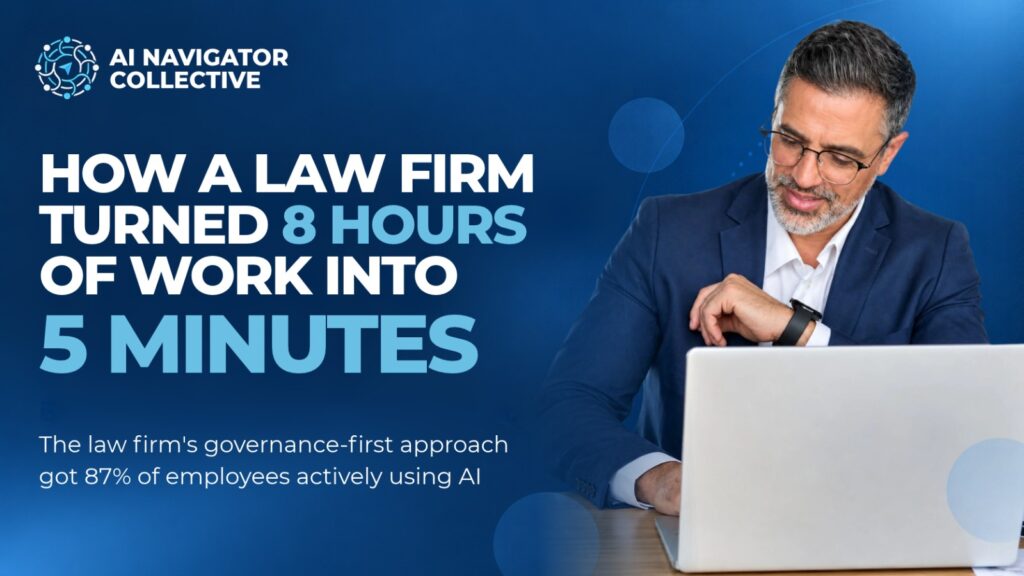
That’s why we found the story of Gilbert + Tobin, one of Australia’s leading corporate law firms so compelling. The firm reports that certain compliance checks that previously took three to eight hours can now be completed in about five minutes, with a person still responsible for reviewing and approving the results.
What’s notable here is that the firm didn’t achieve this by relaxing its standards. It established clear rules about how AI could be used, gave employees practical training, and made sure people remained accountable for the work. By June 2026, 87% of its enabled ChatGPT Enterprise seats were actively being used.
For a law firm handling sensitive client information, that’s significant. There’s a lesson here for businesses that have been hesitant to move forward with AI because they’re worried about the risks.
Start With Work You Can Safely Improve
Gilbert + Tobin didn’t introduce AI across every part of the firm at once. It started with operations teams, where employees could experiment with practical applications in a more controlled environment. As the firm gained experience, it expanded access into marketing, recruitment, finance, business development, and other departments. Legal-specific work continued to use separately approved platforms.
Before expanding, the firm established guidelines for what employees could use AI to do, what information they could share, and how the results needed to be reviewed. It also evaluated security protections, access controls, and data-handling requirements.
None of that sounds particularly exciting, but it’s what made broader adoption possible. Instead of leaving employees to figure out the risks themselves, the firm gave them clear boundaries they could work within.
This is where we see a lot of smaller businesses get stuck. They’re either allowing employees to experiment without much guidance or restricting AI because they aren’t sure what’s safe. There’s a middle ground where people understand which tools are approved, what information needs to stay protected, and when a person needs to check the work.
The Results: Eight Hours Down to Five Minutes
One of Gilbert + Tobin’s most impressive examples involves compliance checks. The firm used OpenAI’s Codex to help develop a workflow for selected conflict-of-interest, know-your-customer, and anti-money-laundering checks.
Previously, some of these checks required three to eight hours of research and processing. The AI-supported workflow can now produce a report in approximately five minutes. A person still reviews the findings and signs off before the check is considered complete.
The firm has seen similar improvements elsewhere. One recruitment research task dropped from about four hours to 20 minutes, while other AI-supported workflows helped prepare audit reports and organize more than a thousand files.
The important distinction is that the technology is handling much of the repetitive work, not taking over responsibility for the final decision. Employees can spend less time gathering and organizing information and more time evaluating whether the result is accurate.
For businesses that worry about losing control when they introduce AI, this is a useful example of how automation and human oversight can work together.
Why 87% of Employees Were Using AI
The other number that caught our attention was Gilbert + Tobin’s adoption rate. By June 2026, 87% of employees with enabled ChatGPT Enterprise seats were actively using the technology, according to the firm’s reported results. That’s more than twice the adoption rate it typically sees with other new tools.
The firm didn’t get there by setting usage quotas. CEO Sam Nickless shared examples of how he was using AI in his own work and encouraged employees to see it as a legitimate way to get things done. The business transformation team then met with individual departments to demonstrate applications relevant to their everyday responsibilities.
I think that approach matters more than we sometimes realize. Showing a finance employee how AI can help with financial analysis is much more useful than giving them a generic demonstration of everything ChatGPT can do. The same goes for someone working in sales, customer service, or operations.
People are more likely to try something when they understand how it helps them do their own jobs. And they’re more comfortable using it when leadership has made the expectations clear.
How This Applies to You
You don’t need a law firm’s compliance department or a large technology budget to apply the lesson from Gilbert + Tobin.
Start by identifying a few tasks where AI could save meaningful time without creating unnecessary risk. Make sure employees know which tools they can use, what information they shouldn’t share, and which results need human review. Then show each team how those tools can help with work they’re already doing.
If your company has an AI policy, I’d encourage you to take another look at it. Does it simply tell employees what they’re not allowed to do, or does it also help them understand where they can confidently use AI?
Gilbert + Tobin’s experience suggests that clear guidance and practical training can make it easier for people to adopt AI, even in an industry where mistakes carry serious consequences.
Good AI governance shouldn’t just protect your business from what could go wrong. It should also help your employees understand what’s possible.
Looking for practical ways to help your team use AI? Explore our free and low-cost AI training resources to build skills and put them to work.
Want to Learn More?
- What Is AI Governance? A Simple Guide for Small and Medium Business Owners
- AI Governance Best Practices Every Organization Should Follow
- AI Risk Management: Strategies, Tools & Frameworks to Control AI Risk
- What Wipro, Mercy, and Wayfair Did With the Hours AI Gave Back
FAQ
What is AI governance?
It’s the set of policies, processes, and responsibilities that guide how an organization uses AI. It includes which tools and tasks are approved, how sensitive information is protected, who reviews AI-generated work, and who is accountable for the results. Effective governance helps businesses manage risks while allowing employees to use AI productively. In OneTrust’s 2026 governance survey, 96 percent of respondents said at least one AI initiative was slowed or complicated by governance requirements in the past year. Gilbert + Tobin set its oversight up front and saw adoption more than double its usual rate for new tools. Key Lesson Here: Go Slow to Go Fast.
What are the three pillars of AI governance?
There isn’t one universally accepted set of three pillars, but businesses can start with three practical areas: clear rules for acceptable AI use, human oversight and accountability, and security controls that protect sensitive information. Together, these help employees understand when they can use AI, how to check its work, and what information must be protected.
Does AI require human oversight?
The amount of oversight depends on the task and its potential consequences. Low-risk activities may need minimal review, while decisions involving finances, legal obligations, sensitive information, or customer relationships often require stronger controls. Gilbert + Tobin, for example, uses AI to prepare compliance reports but keeps a person responsible for reviewing and approving the final results.
How can business leaders encourage employees to adopt AI?
Start by demonstrating how AI helps employees with tasks they already perform. Provide training tailored to individual departments, establish clear rules for safe use, and have leaders demonstrate their own use of the technology. Gilbert + Tobin followed this approach without imposing usage targets and reported 87% active use among enabled seats.